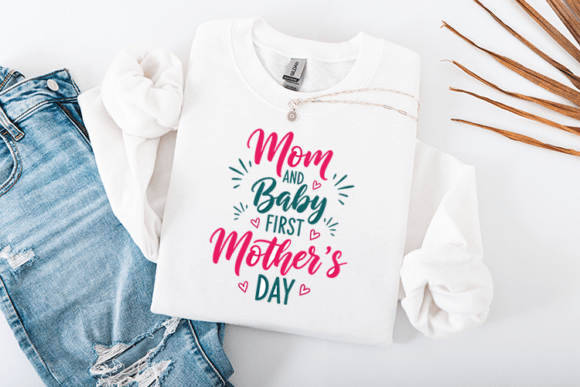
Mom and Baby First Mother’s Day SVG
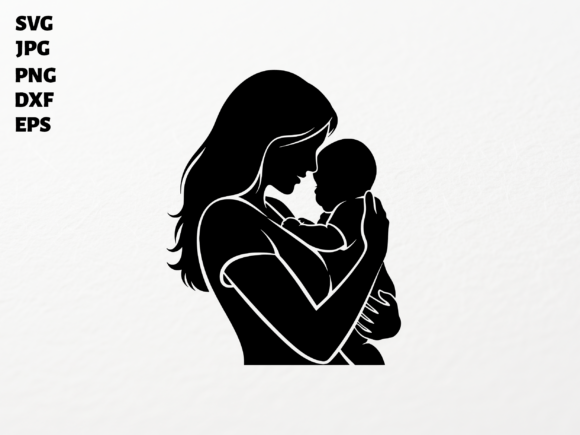
As someone who’s stitched hundreds of motherhood-themed designs—from nursery wall hangings to boutique baby onesies—I opened Mom and Baby First Mother’s Day SVG expecting warmth, simplicity, and embroidery-readiness. What I found was a clean, emotionally grounded design that reads instantly: two figures, gentle curves, soft spacing, and quiet intention. No clutter. No overwrought script. Just presence. It’s the kind of graphic that feels handmade even before it’s stitched—because its lines breathe like pencil sketches translated into vector form.
I tested it on a custom embroidered cotton tote for a local gift shop owner preparing for early May orders. The client wanted something tender but not saccharine—something moms would actually *keep*, not tuck away after the holiday. We chose a natural canvas tote with cream thread. The Mom and Baby First Mother’s Day SVG held up beautifully: the proportions scaled cleanly to 8 inches wide (within the 12×12 inch native size), and the open negative space between the figures gave the embroidery room to land without crowding. No fill-stitch bleeding. No satin-stitch distortion on the curved arms. That tells me this isn’t just a pretty JPEG—it’s built with stitch logic in mind.
This design shines brightest where emotional resonance meets practical execution: on baby blankets, linen pillow covers, unbleached tea towels, and lightweight sweatshirts. Its balanced layout works equally well centered on a onesie chest or nestled in the corner of an apron pocket. As a machine embroidery design, it avoids common pitfalls—no micro-details that vanish at 3–4x scale, no overlapping outlines that confuse auto-digitizing software, and no dense clusters that risk puckering thin knits. If you’re an Etsy seller listing personalized gifts or a small shop owner curating seasonal merchandise, this is the kind of embroidery file that converts because it looks thoughtful, not templated.
That said, use caution on stretchy fabrics like jersey or ribbed cotton. The design’s gentle curves rely on stable tension—if your stabilizer isn’t firm enough or your hoop isn’t snug, those soft shoulders can blur. On dark fabric, test contrast carefully: the original JPG and PNG previews don’t indicate thread recommendations, so run a black-and-white mockup first. And while the 3600×3600 pixel resolution gives plenty of headroom for resizing, don’t push below 4 inches wide without checking fine edges—especially around the baby’s hands and the subtle contour of the mother’s neckline. Those details hold the design’s tenderness; if they soften too much in stitching, the emotional weight flattens.
For commercial embroidery projects, the Mom and Baby First Mother’s Day SVG performs reliably across formats. The AI and EPS files imported cleanly into my digitizing software with crisp anchor points. The PDF served well for client approvals. Even the JPG and PNG worked as quick visual references when building printable mockups for social listings—no pixelation, no compression artifacts. As a digital embroidery file, it’s versatile without being vague. It doesn’t try to be everything; it commits to one clear mood and executes it consistently.
Where it fits less naturally: tiny hoops (under 4×4 inches), heavily textured fabrics like bouclé or thick terry cloth, and curved surfaces like structured caps. The design’s gentle flow relies on flat, even ground—and caps demand aggressive underlay and stitch reorientation that this SVG doesn’t inherently account for. Likewise, avoid layering it directly over seams or darts unless you’ve pre-tested stabilization. And while it’s lovely on baby items, skip ultra-fine silk or delicate lace—this is a design meant for durability, not delicacy.
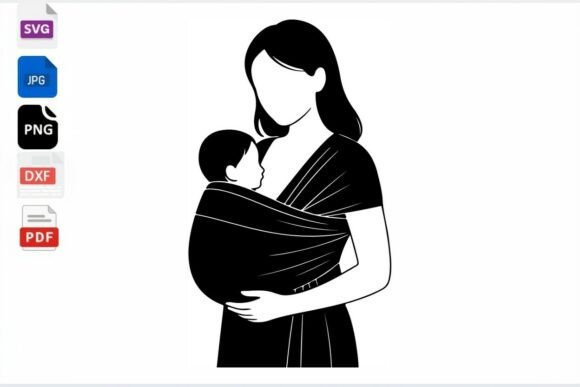
What makes Mom and Baby First Mother’s Day SVG stand out in the Crafts category isn’t novelty—it’s restraint. So many “first Mother’s Day” graphics lean into cutesy fonts or cartoonish proportions. This one trusts the subject. The figures are simplified but not generic; their posture implies connection without spelling it out. That subtlety translates directly to perceived value in finished products. A customer receiving an embroidered kitchen towel with this design doesn’t think “cute clipart”—they feel seen. That builds trust. That encourages repeat orders. That makes your craft business feel human, not algorithmic.
Before using it in your next batch, here’s what I recommend:
- Run a test stitch on scrap fabric matching your final product’s weight and weave
- Check thread color contrast on both light and dark backgrounds—not just digitally, but physically
- Review stitch density in your embroidery software: look for areas where fill stitches might compress too tightly near curves
- Confirm your hoop size comfortably accommodates the design at your intended scale—don’t assume 12×12 means “fits any hoop”
- Inspect small details at 200% zoom in your vector editor: are anchor points smooth? Are there stray nodes?
- Use cutaway stabilizer for woven fabrics, tear-away for stable knits—this design benefits from clean backing support
- Verify licensing terms before selling finished embroidered items or reselling the digital file—this is critical for Etsy sellers and craft businesses
As a designer who evaluates hundreds of embroidery files yearly, I judge Mom and Baby First Mother’s Day SVG not by how many formats it ships in—but by how little it asks you to fix. It arrives ready, respectful of fabric, thread, and feeling. It’s the kind of design that disappears into the product—so the mom holding that embroidered pillow, or the grandma unfolding that tea towel, only notices love. Not stitches. Not software. Just care, made visible.
If you’re building a collection of meaningful, production-ready Graphics for handmade products—or simply choosing your next best-selling embroidered patch or tote bag design—this one earns its place. Not because it shouts, but because it listens.