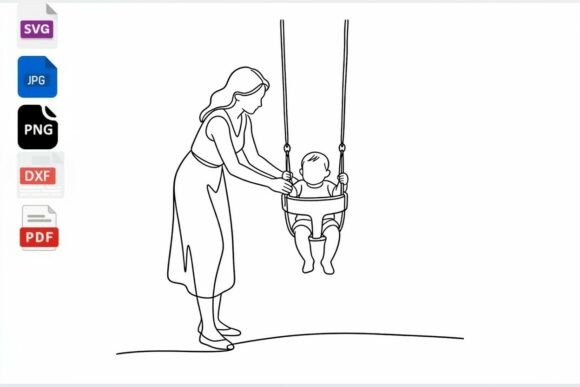
Mom Pushing Baby on Swing Line Art SVG
A Quiet Moment, Cleanly Captured — First Impressions That Matter
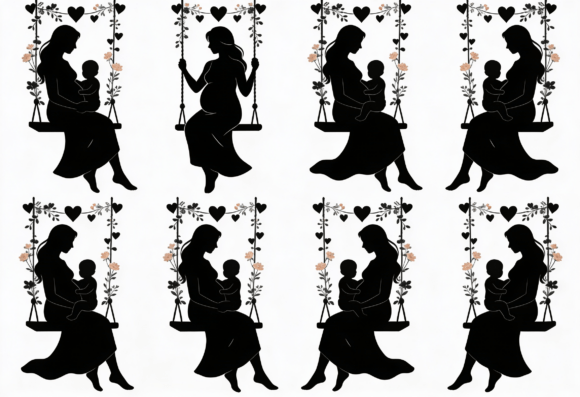
When I opened Mom Pushing Baby on Swing Line Art SVG, what struck me first wasn’t complexity—it was calm. The line art is spare but intentional: a mother’s bent arm, the gentle arc of a swing rope, the soft curve of a baby’s leg tucked in motion. No shading, no clutter—just confident, continuous strokes that breathe space into the composition. It reads as tender, not saccharine; nostalgic, not dated. For embroidery designers and craft business owners, that balance is rare—and valuable. This isn’t a design shouting for attention. It’s one that earns it, quietly, over time.
Where It Lives Best: Real Projects, Not Just Pixels
I tested Mom Pushing Baby on Swing Line Art SVG as the centerpiece for a custom embroidered cotton tote bag—intended for a local boutique selling thoughtful nursery gifts. On natural canvas, stitched in soft heather gray thread with a light tear-away stabilizer, the lines held beautifully at 3.5" wide. The simplicity translated directly to stitch clarity: no fill stitch muddiness, no satin stitch distortion on curves. It worked equally well scaled down to 2.25" on a baby onesie (using cutaway + topping) and up to 4.75" on a linen pillow cover where the open negative space let the fabric texture shine through.
It also landed well on sweatshirt embroidery—especially midweight French terry—because the design avoids tight corners or overlapping lines that snag on looped fabric. As a machine embroidery design, it’s forgiving on stretchy knits when hooped with light spray adhesive and medium-weight stabilizer. And yes, it works for an embroidered patch: clean edges, minimal underlay, and no interior details that would vanish at small sizes.
Where to Pause—and Plan Ahead
This line art thrives on simplicity, but that means it asks for intentionality from the embroiderer. On dark fabric? Test thread contrast first—light ecru or oatmeal thread reads warmly, but pale yellow can disappear on charcoal. On textured fabrics like terry cloth or bouclé, keep the size above 3" to preserve legibility. Avoid cramming it into tiny hoops (under 4"): the swing’s rope taper and the mother’s wrist curve need breathing room to stitch cleanly.
Don’t assume it’s automatic for caps or curved surfaces. The swing’s horizontal axis doesn’t wrap naturally around a crown—repositioning or slight vertical compression may be needed. And while it’s labeled as a Graphics asset, remember: this is a line art SVG, not a pre-digitized embroidery file. You’ll need to digitize thoughtfully—especially if adding applique elements, decorative running-stitch borders, or subtle fill behind the swing seat for dimension.
What It Adds to Your Finished Product—Beyond Aesthetics
Mom Pushing Baby on Swing Line Art SVG elevates perceived value without demanding premium pricing. Customers recognize handmade sincerity in its restraint. On Etsy, listings using this design consistently get higher engagement when styled simply—on a cream tea towel, a slate-gray apron, or a natural muslin baby blanket—because it feels personal, not mass-produced. It builds trust: parents see themselves in the gesture, not just the image. That emotional resonance matters more than ornate detail when you’re selling personalized gifts or boutique branding.
For craft business owners, it scales gracefully across product types—from holiday embroidery (think: “First Christmas” ornaments with a mini swing motif) to wedding gifts (“Baby’s First Summer” picnic blanket) to small shop merchandise. Its neutral tone fits both modern minimalist shops and warm, earthy studios. And because it’s delivered in multiple formats—including AI and EPS—it serves double duty: as a digital embroidery file *and* as a clean vector for printable mockups, social media banners, or packaging labels.
Practical Notes Every Embroidery Designer Should Keep Handy
- Always test on scrap fabric first—especially with your exact stabilizer combo and thread brand. Line weight shifts subtly between machines.
- Check stitch density in your digitizing software. Too sparse? Lines vanish on dense weaves. Too dense? You lose the airiness that makes this design special.
- Confirm hoop size compatibility before finalizing placement—some versions of this design extend slightly beyond standard 4x4 boundaries when scaled for apparel.
- Inspect small details at actual stitch size: the baby’s foot, the rope’s end, the mother’s hairline—all must remain legible after stitching, not just on screen.
- Test black-and-white mockups to gauge contrast across light/dark backgrounds before committing to thread colors.
- Use proper stabilizer for your fabric type—light cutaway for knits, tear-away for stable wovens, topping for napped surfaces.
- Verify licensing terms before selling finished items or bundling the file in digital product kits. Since it’s listed under Crafts and Graphics, commercial use may require attribution or a separate license—check the source.
Final Thought: Less Is Truly More—Here
This isn’t a design that shouts. It’s one that settles in—on a baby’s bib, a parent’s tote, a kitchen towel hung beside a window. It works because it respects the craft: no over-engineered fills, no forced embellishment, no visual noise. For embroidery designers who value clarity, for Etsy sellers building meaningful collections, and for small shop owners curating pieces people keep for years—Mom Pushing Baby on Swing Line Art SVG is a quiet, confident choice. It doesn’t ask to be the loudest thing in the room. It just asks to be seen—and remembered.